Letter: To Miss M. A. Hood, Stoughstown, PA from John Zug, 1839
“All or nearly all our lawyers here are ungodly men, not only irreligious but most of them profane. These are my companions often—too often.”
John Zug, a new lawyer, writes to his intended bride Margaret about the perils to his mind, body, and soul of being a lawyer. He is determined to follow a new regimen to improve his health.
Carlisle December 16, 1839
My own dearest Margaret,
Strange have been my feelings since I left you on Sabbath week. I was sick then, and but for my indisposition I should not have left you on Sunday and so soon as I did. I felt that I was being taken severely ill and had better be at home. I was not disappointed in my notions of my health, for I had scarcely got home, when I was half roasted with a violent fever which continued until the next day. I was more or less sick for several days and probably worse than I would have been, because I suffered business to keep me in my office or in the street or in the Co. House where a sick man should never be found. From your father I suppose you learned of our famous trial from Newville. It was not my case but of Adair’s cooking. I was merely called in to help eat the dish when cooked. The whole amount of it was that Mrs. House had not prepared the right kind of testimony.
I don’t know whether you know it or not but your father before he left Carlisle on Wednesday last, made himself my client by giving me a case of collecting money from Mr. John Moore, my first client. I also had another client this morning who entrusted to my case the bringing of a suit against Jacob Weibley so that I think I need not despair having had four clients already. But I tell you, my dear, the practice of Law is not the easy kind of business men imagine it to be. To one of my warm and ardent temperament it is almost dangerous. So much care, thought, and anxiety on so many different subjects all in the mind at the same time, weigh it down, or fret, and excite it so much to an extent almost to break it to pieces. When I have important cases on hand I know they will always be fretting and exciting my brain, so as to almost split it. And then this excitement almost invariably produces headaches. The little that I have done shows me plainly to the moral difficulties in the way. So many temptations to take advantage when in strict moral I am prohibited. But this there is no necessity of doing; and I an convinced that I may be a practicing lawyer and a devoted Christian at the same time. Whenever I find it otherwise my Law shall go to the dogs and I’ll adopt a more honest means of obtaining a livelihood. But I apprehend that greatest ill I find will be the character of the company I am compelled to keep. All or nearly all our lawyers here are ungodly men, not only irreligious but most of them profane. These are my companions often—too often. My purpose is fixed however to have no more to do with them than needs be and above all to maintain my own integrity and not be “ashamed of the Gospel of Christ.” My daily prayer to God is that I may stand fast “always abounding in the works of the Lord” and that no temptation shall lead me to adopt the decrees of the enemy.
I have during the past week written to our good friends Moore & Bowman and expect answers before a great while. I urged Bowman to use all his influence with Mathilda to induce her to go to Mt. Joy. My own impression is that both of you would find it pleasant and improving and that you never, either of you, regret the time you spend there. My own mind is made up. All the influence I can use shall be exerted in persuading you to go.
As I before remarked—I have suffered no little from sickness the past week. My own impression is that my constitution is very much out of repair and that I need a regular system of conduct and diet to restore me to the vigor of health with which I have been long blessed though I never was constitutionally strong. I intend to be careful with my health, habits, diet, and so do all I can; I am now taking a course of prescribed medicines and intend living less flesh and more on vegetable food etc., then formerly. I am taking a very pleasant kind of pectoral gum called “Irish Moss.” I find it quite delightful to take—on the whole though not well yet. I feel I am getting stronger and can and do cheerfully attend to all of my business. I don’t read a great deal of hard reading at this time but have taken up some light reading and such as will make my “laugh and be fat.”
With all the sentiments of love which I can cherish I write myself, Yours, John
John Zug would die four years after he wrote this letter. He was 26 years old. He was living in Baltimore when he married Margaret Ann Hood on July 28, 1841, in Springfield, Cumberland County. She was the daughter of Col. Josiah Hood of Springfield. John Zug graduated from Dickinson College with honors. He studied law and was admitted to the Bar. His obituary stated that “At several times, however, he was diverted from the pursuit of his profession, but what he considered the calls of public duty… He was Principal first of the Grammar School of Dickinson College, and afterwards a Classical School in Baltimore…While living in Baltimore he became particularly interested in the movements of the Washington Temperance Society…His frequent exertions in public speaking, especially in the open air, brought on haemorrhage [sic] of the lungs. From that time his health began to decline, and he was soon compelled to relinquish his school.”1 When he married and returned to Carlisle he practiced law. He was also one of the Directors of the Cumberland County Poor House. John died in Carlisle on September 5, 1843. His widow Margaret later married Dr. Baughman of Carlisle and died in 1894.
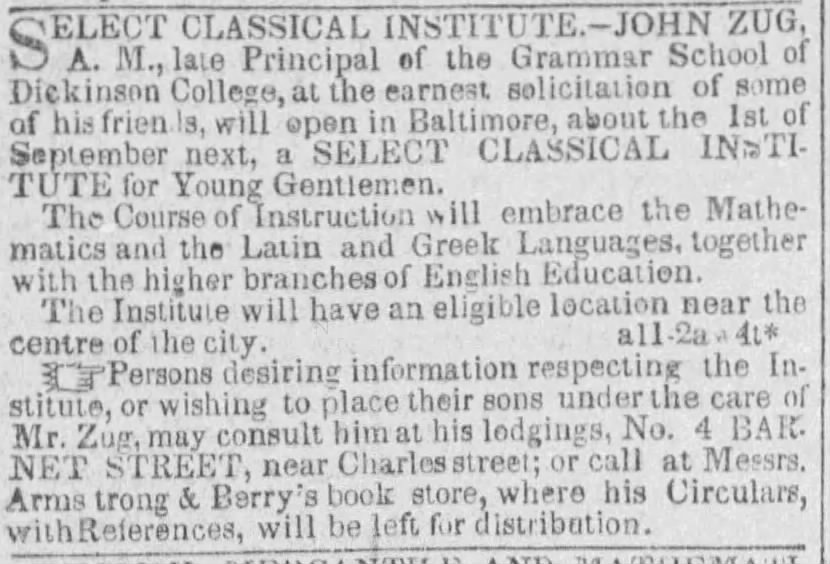 John Zug’s advertisement for his Select Classical Institute in the August 18, 1840, issue of The Baltimore Sun newspaper.
