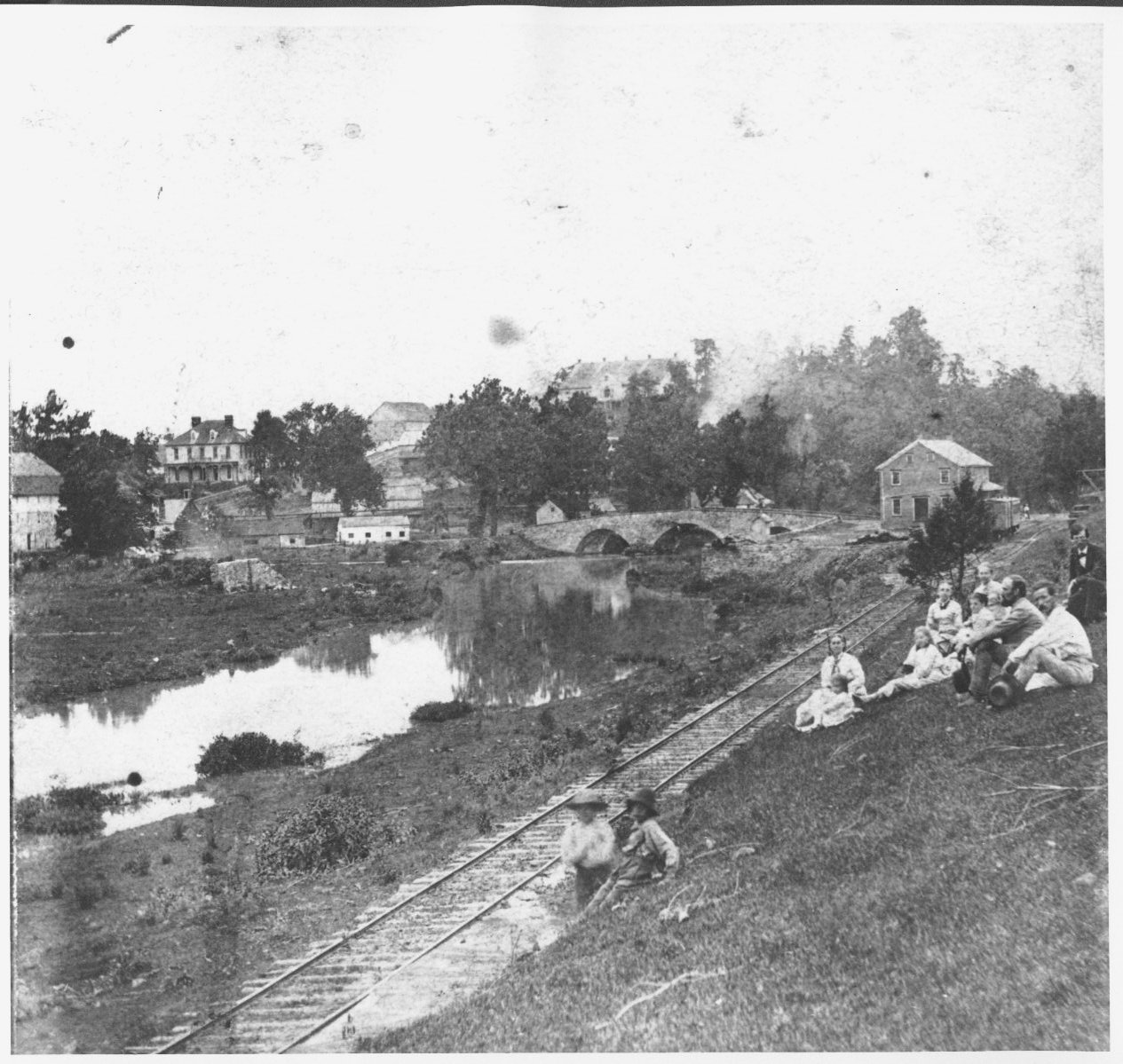
Peter Whitmore was born circa 1784. He was married twice, had eleven children and made his living as a blacksmith at the Carlisle Iron Works in Boiling Springs. We get a glimpse of his life from a series of Cumberland County court records.
In 1820 Peter was a 36 year-old blacksmith working at the Iron works in Boiling Springs. Peter, his wife, sons John, Joseph, Henry, and Peter and their daughter Eliza likely lived in one of the houses that Peter rented from the company. There is supposition that laborers at the iron works lived in houses in the area behind the Mill running toward the Yellow Breeches Creek and along its west bank.1
Working conditions at an iron furnace were physically taxing. It was an environment of continual heat from the furnace and the charcoal fires, constant noise, and the risk of accidents. The hours were long, pay was minimal, and many of the workers were poor. Tax assessments for the 1820’s show that the only property Peter owned was one cow. Fortunately, in 1809 Pennsylvania passed an Act for the education of poor children2 between the ages of five and twelve. Parents who qualified could send their children to the closest school free of charge. We know the names of some of Peter’s children because teachers were required to keep a day book to record the names of the poor children, the number of days they taught them, and any items purchased for them such as stationery, reading and spelling books, slates, etc. Teachers were required to submit their reports to the County Commissioners to receive their pay.
On February 7, 1820, teacher Abram Embeigh presented his account to Justice Elisha Doyle for teaching paupers at “the Boiling Springs School House” from November 7, 1819, to February 7, 1820. His report states that the charge for teaching Peter Witmer’s “two sons and daughter viz: Henry, Joseph, and Eliza” for 176 days was $5.72. His account included the names of the children of Joseph Mc Kendrick and David Holiday.3 The 1820 census showed that Joseph McKendrick lived two doors away from Peter Whitmer, and David Holiday’s family lived close by.
John Taylor replaced teacher Abram Embeigh in 1822. His account for July 1, 1822, to January 1, 1823, records that he taught Eliza for 26 days, and Joseph for 29 days. From January 2, 1823, to April 1, 1823, he taught Eliza 59 days and Joseph 47 days.4
Peter’s first wife died sometime between 1820 and 1824. On March 16, 1824, Peter married his second wife, Mrs. Elizabeth Miller of Adams County, Pennsylvania, and they had six children, George, Amos, Daniel, John, Rebecca, and Maria. Peter was able to buy a piece of land, but his health had deteriorated, and he could not support his family. He was suffering from asthma and dropsy.5 Peter lingered for a year and a half before dying in December 1849 at the age of 66. Peter’s will stated that my wife Elizabeth is to have the house and lands I now live on as long a she remains a widow. If my boys and girls live with her and take care of her until her death or marriage, I will that the house and lands be appraised by two or three neighbors and disposed of as my six children think proper. To George I will 1/6 of it, a machine to bend tire iron with, blacksmith tools, and $25. The remaining five children, Amos, Daniel, John, Rebecca, and Maria get equal shares of the house and lands. I will to the children of my first wife viz: John Whitmore, Joseph, Henry, Peter and Eliza married to Amos Steen $5 each. “The reason I will more to the children of my last wife is because they stayed with me after they were raised and kept me and made a living for my family which I would not have been able to do myself." 6
On December 28, 1849, Peter’s goods were sold at vendue. The vendue lists every item that was sold, the name of the purchaser, and the cost of each item. Peter’s son George bought bushels of coal, and lots of iron as well as his father’s mare, saddle and bridle and other items. Peter’s widow bought the cow. Peter’s executor William R. Sadler bought a Crout cutter, chains and iron. Seventy five items were sold for a total of $118.13 ½ cents.7 If there is a grave stone for Peter, its whereabouts are unknown.