John Pollock and the Philadelphia newspapers
Carlisle tavernkeeper John Pollock was a man with many irons in the fire including providing Philadelphia newspapers to those in Carlisle and the hinterland.
Carlisle tavernkeeper John Pollock was a man with many irons in the fire including providing Philadelphia newspapers to those in Carlisle and the hinterland.
Being the wife of a tavernkeeper meant that Elizabeth helped with the running of the tavern as well as taking care of her family. Washing, cleaning, cooking in a hot kitchen over a fire for hours as well as helping in the barroom was hard work.
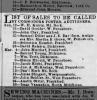
In the spring of 1900, Commodore Porter of Plainfield, had recently finished his twentieth sale of the season. A Chambersburg newspaper reported that he was “in his sixty-fourth year and is still hale and hearty and hopes to call many more sales.”1 It was not to be.
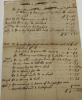
“John Proctor was a well-known figure in the industrial world of Carlisle in the early days; he made bits when they were made and filed and plated by hand, silver money being melted to get material for the plating.” Proctor was working in Carlisle as early as 1812 according to a bill he submitted to the County Commissioners for work done at the jail and the court house. The work included making locks, keys, and hinges for window shutters.
“Carlisle’s strongest white man was “French George” who had a brother “French Ory,” and a sister who was the wife of Jimmy McCarter the carpet weaver. Rathgueb was the family name. We question if the old town has since boasted of male citizens of equal strength.”1

Conrad Reep, his wife Catharine (Lizman) and their two young daughters emigrated from Hesse-Darmstadt, Germany in 1848. Reep’s brother-in-law, John Lizman, also from Hess-Darmstadt, had immigrated earlier and was a cabinetmaker in Carlisle. Reep settled in Mount Holly Springs, six miles south of Carlisle. In 1856, he declared his intent to become a citizen and was naturalized on November 10, 1858.

Relics are fragments or objects that have survived from the past, and in the case of relics found in Cumberland County, they are gold and silver coins, buttons, silver spoons, and cannonballs.

Mrs. Ross, as her name was written on the “Applyers of Lots” in Carlisle in 1751, may have been the wife of John Ross, keeper of the Blue Rock Ferry in Hempfield Township, Lancaster County, Pennsylvania, who according to court records, turned his wife Elizabeth out of his house in 1737. In 1741, he was ordered to pay her 3 shillings and 6 pence per week for her support.
Maximillian Sappelt and his parents Joseph and Ottillia Sappelt left the port of Hamburg, Germany on June 1, 1867 aboard the ship “Cimbria” bound for America.1 They settled in New York City where Joseph Sappelt practiced medicine, and Max went to school.2
Interview of Merri Lou Schaumann for the Elizabeth V. and George F. Gardner Digital Library Memory Bank. Schaumann discusses growing up in Euclid, OH before coming to Carlisle, PA. During her time in Carlisle she became a prolific researcher of local history leading to the publication of numerous books and volunteering with the Cumberland County Historical Society.